2,7-Anthraquinone Disulfonic Acid Disodium Salt is a composite organic compound with excellent premium redox properties and stability. It is extensively used in electrochemistry areas such as lithium-ion battery technology and advanced energy storage systems; 2,7-AQDS actively contributes to the enhancement of battery efficiency by boosting the energy density, cycle life, and general performance of lithium-ion and lithium-polymer batteries. It is a mediator and stabilizer of electrolytes, hence being perfect for stable voltage and power transactions in a streamlined manner.
The high solubility of the compound in aqueous and organic solvents and its chemical structure make it especially effective for a wide range of battery chemistries. As the need for more efficient and lasting energy storage systems rises, 2,7-Anthraquinone Disulfonic Acid Disodium Salt is becoming the major ingredient of the next generation of battery technology for various industrial and consumer uses.
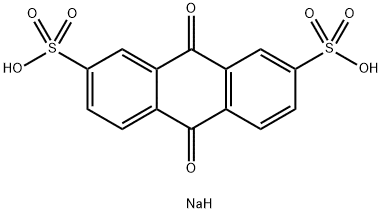
| Property | Details |
|---|---|
| Chemical Formula | C16H12Na2O6S2 |
| Molecular Weight | 426.39 g/mol |
| Appearance | Light brown to yellow powder or crystalline form |
| Purity | ≥ 98% |
| Melting Point | 275°C (Decomposes) |
| Solubility | Soluble in water and most organic solvents |
| Density | 1.47 g/cm³ |
| pH | 6–8 (in aqueous solution) |
| Flash Point | Not applicable (solid) |
| Reactivity | Stable under normal conditions; avoid strong acids |
Chemical Manufacturing
Energy Storage / Battery Industry
Dye and Pigment Industry
Pharmaceuticals and Fine Chemicals
Textile Industry
Research and Development
It is primarily used as an active redox material (electrolyte) in Aqueous Organic Redox Flow Batteries (AORFBs), as an electron mediator in microbial fuel cells, and as a desulfurizing agent in gas purification processes.
The CAS number for 2,7-Anthraquinone Disulfonic Acid Disodium Salt is 853-67-8 (or 853-66-5).
It should be stored in a dry, cool place under an inert gas atmosphere at room temperature to preserve its chemical stability and prevent degradation.
It offers high solubility in water, excellent chemical stability, and highly reversible redox kinetics, making it ideal for scalable, safe, and cost-effective grid energy storage.
Its chemical formula is C₁₄H₆Na₂O₈S₂ and its molecular weight is 412.30 g/mol (or 426.39 g/mol depending on the hydration state).